

Fiscal Fuel Theft, Corporate Security, and Binational Risk.

A New Agenda to Protect North American Value Chains
By Luis Miguel Dena Escalera, CEO of BlackIND LLCVice President, Security CommitteeAmerican Chamber of Commerce of Mexico
For years, the illegal, tolerated, and well-documented theft of fuel in Mexico was understood primarily as a public security issue, a source of patrimonial losses, and a direct threat to the country’s energy infrastructure.
However, the recent evolution of this phenomenon requires us to reassess the analysis. Alejandro Alegre Rabiela, in his contribution “Reflections on National Security and the Economy” in the book National Security in Mexico: Reflections and Proposals from Experience, argues that “national security must be understood from a multidimensional perspective, and not solely from the traditional standpoint of security and national defense. The economic and commercial dimension has acquired critical relevance… and its stability depends largely on its economic integration with the United States of America.”
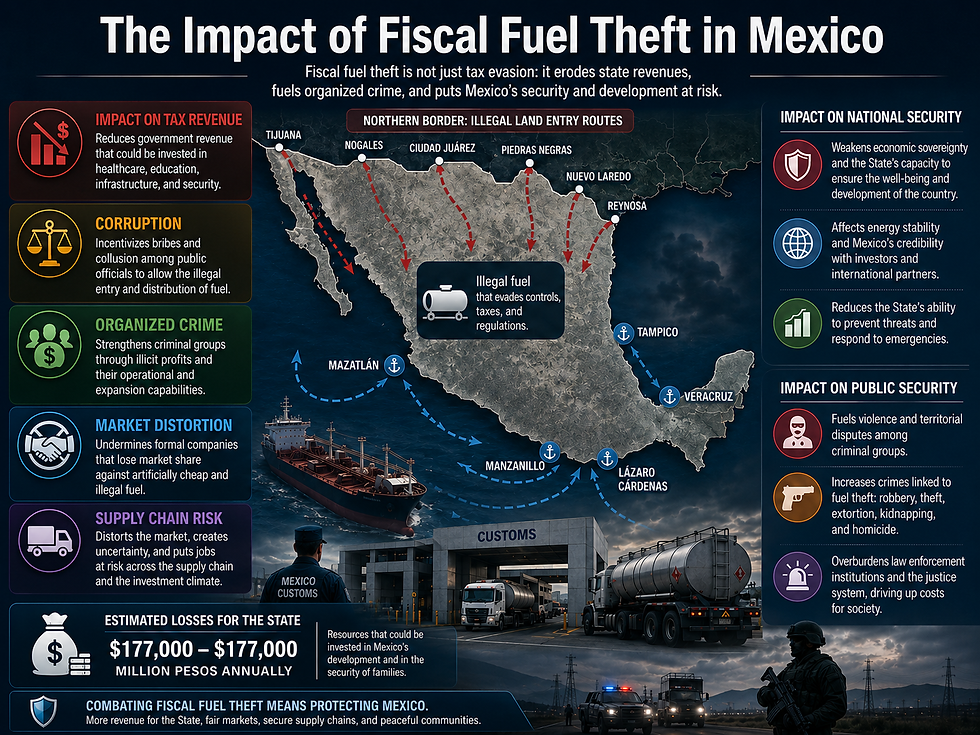
From my perspective, therefore, fiscal fuel theft can no longer be viewed only as smuggling, tax evasion, or a black market for hydrocarbons. Today, it represents a complex threat to national security, the integrity of foreign trade, economic competition, corporate compliance, and the stability of supply chains between Mexico and the United States.

From the standpoint of corporate security, the critical issue is not only the illicit fuel itself, but the architecture that makes it possible: front companies, brokers, traders, carriers, altered customs documentation, misused permits, false invoicing, storage yards, distribution networks, service stations, international payments, digital assets, cash, luxury goods, real estate, and potential mechanisms of institutional corruption. In other words, we are facing a business-criminal system that operates under an appearance of legality and exploits weaknesses in energy, tax, customs, financial, and logistics regulation.
Ricardo Ravelo and José Luis Montenegro, in their book The Fourth Transformation of Organized Crime, note that fuel trafficking networks did not operate solely at the level of criminal groups; they also reached senior officials in customs and the Secretariat of the Navy. Likewise, Raúl Olmos, in his book Fiscal Fuel Theft: The Mother of All Frauds, confirms on page 37 the transcription of a 2019 call that reveals institutional personnel linked to port operations and areas of southeastern Mexico allegedly protecting criminal actors. Based on information from Guacamaya Leaks, the journalist presents clear evidence that the Federal Government, through honest public servants, was aware of the growth of this phenomenon through its intelligence bodies, fusion centers, and authorities.
As the private sector, we must collaborate much more actively in corporate compliance. FinCEN recommends that financial institutions review whether energy-sector clients receive payments from Mexican companies without SENER permits, validate export documentation, identify beneficial owners, and assess whether transactions are consistent with normal practices in U.S.–Mexico energy trade.
For this reason, the FinCEN alert issued in June 2026 and OFAC’s related actions confirm that the U.S. Government is interpreting this phenomenon as part of a transnational threat associated with Mexican criminal organizations, as well as corruption involving certain public officials and political actors.
Fiscal fuel theft no longer affects Mexico alone; it also involves companies, banks, intermediaries, and commercial chains located in U.S. territory. The binational dimension of the problem requires a binational, coordinated response based on collaboration, institutional intelligence, and private-sector protection mechanisms.
For the private sector, this implies a paradigm shift. It is no longer enough for a company to have its own documentation in order; it must also understand whether its counterparties, suppliers, clients, carriers, brokers, logistics operators, or beneficial owners are part of a risk network. In industries such as energy, transportation, logistics, private security, storage, foreign trade, banking, insurance, retail, manufacturing, and distribution, traditional compliance programs may be insufficient unless they incorporate risk intelligence, link analysis, documentary traceability, and financial monitoring.
The case of fiscal fuel theft demonstrates how a criminal threat, which after 2025 may also be framed under terrorism-related risk depending on designations and support structures, can insert itself into apparently ordinary operations: imports, cargo transportation, regulatory permits, distribution contracts, invoices, international payments, newly incorporated companies, residential addresses, atypical profit margins, or customers without real infrastructure.
In the eighth edition of the Security Tool for Supply Chain Actors, Jesús Eduardo Moreno and Miguel Velázquez of the Business Alliance for Secure Commerce, BASC Colombia, clearly refer to the “reconfiguration of the threat landscape beyond traditional paradigms.” They address the criminal metamorphosis within digitalized systems. I would add that this level of sophistication requires binational companies operating between Mexico and the United States to strengthen their due diligence processes, not only from a legal perspective, but from a strategic security standpoint.

In the North American context, the review of the USMCA/T-MEC, nearshoring, the relocation of production chains, and energy integration make it essential to protect operational trust between Mexico and the United States. Binational trade cannot be strengthened if logistics chains remain vulnerable to criminal structures that manipulate permits, routes, documents, payments, and intermediary companies. Corporate security therefore becomes an essential component of regional competitiveness.
In my proposal to the Security Committee of the American Chamber of Commerce of Mexico, this conversation must be elevated to a more strategic level so that we can consolidate our position as a business reference point in the identification, analysis, prevention, and management of complex risks that impact member companies, their employees, supply chains, operations, and reputation.
The guiding pillars should be: institutional continuity, security as a business enabler, collaborative leadership, public-private cooperation, and cross-cutting integration among AMCHAM committees, security committees across chambers, councils, associations, and ultimately member companies.
The 2026–2028 vision and the updating of protocols must build on the continuity of the work already developed and incorporate the best proposals from our members. I therefore extend my personal appreciation to all those who invested their valuable time and experience in proposals to transform security into a strategic function in service of competitiveness, resilience, and economic development. I also recognize that our country will enter a process of treaty review and electoral processes on both sides of the border, where every contribution will be substantive.
The objective is to build a corporate security agenda that connects intelligence, compliance, foreign trade, anti-money laundering, cybersecurity, physical security, logistics traceability, and public-private cooperation. The modern company must understand that its exposure does not end at its facilities; it extends to suppliers, third parties, contractors, transportation, payments, documentation, permits, and reputation.
Fiscal fuel theft also reminds us that national security and corporate security are no longer separate agendas. When a criminal network captures segments of the energy chain, erodes tax collection, finances violence, distorts markets, corrupts authorities, and competes against legitimate companies, the impact directly reaches the State, investment, and the formal private sector. Every illicit liter is not only an act of tax evasion; it is a failure of integrity within the economic system.
The macroeconomic dimension is clear: FinCEN notes that these networks divert tens of billions of dollars annually in fiscal revenues from the Government of Mexico, affect Pemex, and harm legitimate Mexican and U.S. energy companies. It also warns about payments through international wire transfers, stablecoins, structured cash deposits, companies registered at residential addresses, companies without real infrastructure, and pass-through accounts. This connects the issue directly with Anti-Money Laundering, AML; Countering the Financing of Terrorism, CFT; banking compliance; and counterparty risk.
The corporate response must be proportional to the threat. Companies must review their Know Your Customer, KYC; Know Your Business, KYB; and Know Your Supplier, KYS models; verify beneficial owners; confirm import, commercialization, and transportation permits; analyze invoicing patterns; validate real infrastructure; monitor international payments; review red flags in transportation and logistics; incorporate OSINT intelligence; and establish reporting, escalation, and cooperation protocols with authorities.
The opportunity for the private sector lies in anticipation. Companies that integrate risk intelligence, enhanced due diligence, and traceability into their supply chains will be better positioned to protect their operations, reputation, and relationships with international partners. Those that fail to do so may be exposed not only to commercial losses, but also to sanctions, investigations, operational disruptions, and reputational damage.
Mexico and the United States share a border, an integrated economy, and a common responsibility in confronting transnational organized crime. Fiscal fuel theft is a warning sign of how hybrid threats are using formal trade channels to finance illicit activities. In response, corporate security must evolve toward a preventive, collaborative, and intelligence-based model.
The challenge is significant: to protect the formal economy, secure supply chains, and strengthen trust in North America. Security can no longer be viewed as an operational cost. In this new environment, security is a condition for competitiveness, integrity, and resilience.


Comments